City Comparison · Vietnam · 2026
Da Nang vs Hanoi
Vietnam's beach city versus its 1,000-year-old capital. Think Miami vs Washington D.C. — one built for the coast, one built for history. Here is an honest account of what each delivers and who each suits.
The Two Cities
Da Nang
- Population: 1.2 million
- Central Vietnam coast
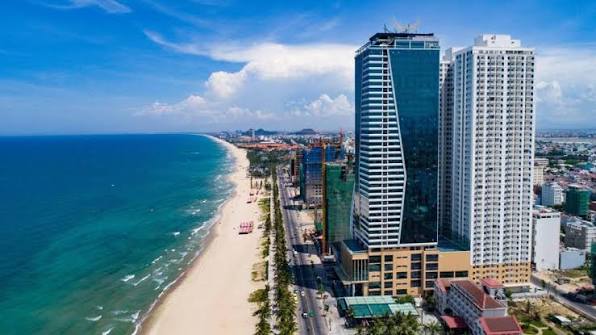
- 35km of beach, year-round warm
- Modern, clean, purpose-built for comfort
- US analog: Miami / San Diego
- Best season: Feb–Aug
- 30 min from Hoi An
- Gateway to Marble Mountains, Son Tra
Hanoi
- Population: 8 million
- Northern Vietnam, political capital
- No beach — inland city
- 1,000+ years as Vietnam's capital
- US analog: Washington D.C.
- Best season: Sept–Nov, Mar–Apr
- 3.5h to Ha Long Bay, 8h to Sapa by train
- The Old Quarter: 36 historic streets
The Washington D.C. comparison is accurate in the best sense: Hanoi carries the weight of Vietnam's national identity the way D.C. carries America's — the government ministries, the museums, the monuments, the embassies, and the sense that something historically important happened here. Da Nang is the Miami comparison: modern, coastal, built for leisure, without the historical layers but with everything you need to be genuinely comfortable.
They are 1 hour 20 minutes apart by air and about 16 hours by train — Vietnam's iconic North-South Reunification Express passes through Da Nang, making them natural partners on a longer itinerary.
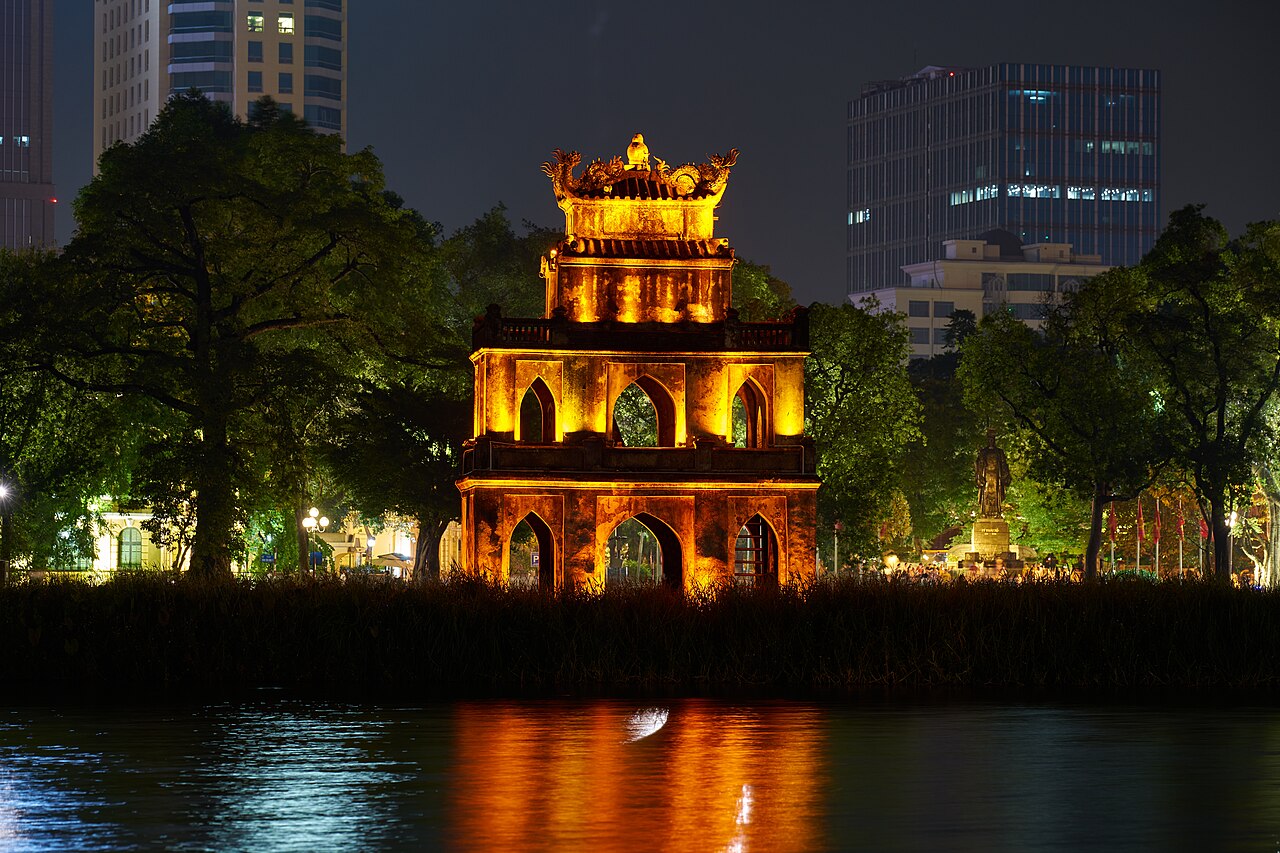
Hoan Kiem Lake at the heart of Hanoi's Old Quarter — the Ngoc Son Temple and the legendary restored sword. One of the most recognisable images in Vietnam.
Side-by-Side Comparison
| Category | Da Nang | Hanoi |
|---|---|---|
| US City Analog | Miami / San Diego | Washington D.C. |
| Population | 1.2 million (manageable) | 8 million |
| Beach | 35km on your doorstep | None — inland city |
| Historical depth | Marble Mountains, Cham Museum | 1,000-year capital, Old Quarter |
| Ha Long Bay access | 1h 20min flight | 3.5h by road |
| Sapa access | 1h 20min flight + transfer | 8h overnight train |
| Winter temperature | 18–22°C (cool, pleasant) | 10–18°C (cold) |
| Summer temperature | 30–35°C | 30–38°C (hotter, humid) |
| Air quality | Cleaner, sea breeze | Variable, worse in winter |
| Street food | Excellent regional cuisine | Vietnam's most iconic dishes |
| Mid-range hotel cost | $80–150/night | $70–140/night |
| 5-star hotel cost | $140–250/night | $150–350/night (Metropole) |
| Walkability | Car/Grab dependent | Old Quarter is walkable |
| Families | Excellent | Manageable |
| Digital nomads | Excellent | Good |
Beach & Outdoors
Da Nang wins this category by default. Hanoi is an inland city — the nearest beach is Ha Long Bay (3.5 hours by road), which is more accurately a limestone karst bay for boat cruising than a beach destination. The nearest proper swimming beach from Hanoi requires a full-day or overnight trip.
Da Nang's 35km of coastline runs directly through the city. My Khe Beach has good infrastructure, consistent clean water from February through September, and reliable south-facing exposure that makes for long afternoon sun. Non Nuoc Beach (10km south) is quieter with better resort concentration. Son Tra Peninsula adds sea turtle spotting, jungle hiking, and private cove swimming that doesn't exist within a day trip of Hanoi.
If outdoor beach time is any part of what you want from Vietnam, this is not a close comparison. For nature in the north, Hanoi's access to Ha Long Bay, Ninh Binh, and the rice terrace highlands of Sapa represents something genuinely different — impressive, but not interchangeable with a beach holiday.
Ha Long Bay — 3.5 hours from Hanoi by road. Dramatic limestone karst scenery, overnight cruises, and kayaking. Not a beach, but a genuinely different kind of natural spectacle.
Culture & History
Da Nang's Cultural Assets
- Museum of Cham Sculpture — world-class, unique
- Marble Mountains — Buddhist pagodas, caves
- Lady Buddha, Son Tra Peninsula
- Dragon Bridge — weekend fire spectacle
- Hoi An Ancient Town (30 min south)
- My Son Sanctuary (1.5h south — UNESCO Cham)
Hanoi's Cultural Assets
- The Old Quarter (36 Streets) — 1,000+ years
- Hoan Kiem Lake and Ngoc Son Temple
- Temple of Literature (Van Mieu, 1070 AD)
- Ho Chi Minh Mausoleum complex
- Vietnam Museum of Ethnology
- Hoa Lo Prison Museum (Hanoi Hilton)
- Opera House, French Quarter architecture
Hanoi wins this category clearly. The Old Quarter is one of the most authentic, dense, and historically layered urban environments in Southeast Asia — narrow streets named after the trades once practised on them, layered architecture spanning seven centuries, and a street food culture that is as much an act of cultural transmission as it is feeding people. The Temple of Literature predates Oxford University by six years. The Ho Chi Minh Mausoleum and the Vietnam Museum of Ethnology are among the most visited cultural sites in the country.
Da Nang's cultural highlight — the Museum of Cham Sculpture — is actually world-class for its specific subject and worth a half-day regardless of itinerary. The proximity to Hoi An and My Son Sanctuary adds significant historical depth. But as a standalone cultural destination, Da Nang doesn't compete with Hanoi's density.
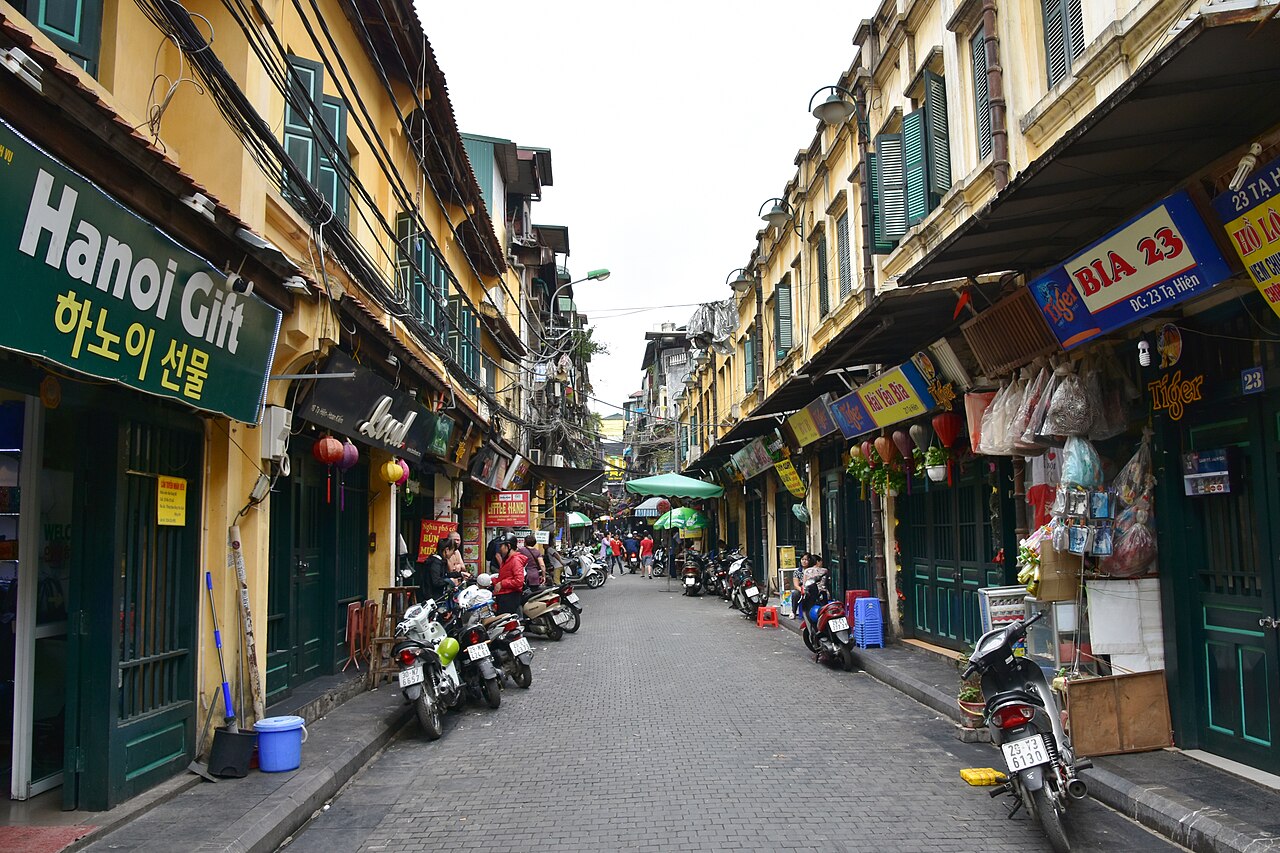
Hanoi's Old Quarter — streets named after the trades once practised on them, layered architecture spanning seven centuries, and a street food culture passed down through generations.
Weather & Seasons
| Season | Da Nang | Hanoi |
|---|---|---|
| Jan–Feb (Winter) | 18–24°C · Mostly dry · Swimmable | 10–18°C · Cool to cold · Misty |
| Mar–Apr (Spring) | 25–30°C · Ideal · Best beaches | 18–25°C · Warm · Good weather |
| May–Aug (Summer) | 30–35°C · Hot · Beach season | 28–38°C · Very hot · Heavy rain |
| Sept–Oct (Autumn) | Typhoon risk · Variable | 22–28°C · Excellent · Best season |
| Nov–Dec (Wet/Cool) | Typhoon risk · Some rain | 15–22°C · Cool · Pleasant |
| Year-round beach? | Yes (with Oct–Nov caution) | No — no beach |
Da Nang has a longer reliable window for beach conditions: February through September gives roughly eight months of warm, dry, swimmable weather. The weakness is October–November typhoon season, which can bring significant rainfall and rough seas.
Hanoi's genuine four seasons are something Da Nang doesn't offer — September through November gives the most pleasant Hanoi weather, with cool clear days, lower humidity, and the city at its most atmospheric. Hanoi's winter (December–February) is genuinely cold by Vietnamese standards — 10–15°C at night — which requires packing layers and dampens the outdoor walking experience. Summer in Hanoi (June–August) can be brutally hot and humid, with afternoon downpours.
For a year-round trip without weather planning complexity: Da Nang. For visiting specifically in September–November: Hanoi's autumn window is excellent and worth targeting.
Hanoi at its best: September through November, when the heat breaks, the humidity drops, and the city's street life moves outside in full force.
Cost of Travel
| Expense | Da Nang | Hanoi |
|---|---|---|
| Budget guesthouse | $20–40/night | $18–35/night |
| Mid-range hotel | $80–150/night | $70–140/night |
| Luxury / 5-star | $140–250/night | $150–350/night (Metropole) |
| Street pho / noodles | $1.50–3 | $1.50–3 |
| City Grab rides | $2–5 (compact city) | $3–8 (larger spread) |
| Beer at local bar | $1–2 | $1–2 |
| Ha Long Bay tour (from Hanoi) | $80–300 (flight + cruise) | $60–250 (road + cruise) |
| Daily budget (mid-range) | $80–120 | $75–115 |
These two cities are remarkably similar in cost at most budget levels. Street food and local dining are effectively identical. The biggest practical difference is that Hanoi's access to Ha Long Bay is significantly cheaper than booking the same cruise from Da Nang — the overland distance makes it a day trip option from Hanoi that doesn't exist from Da Nang without a flight.
Pros & Cons
DA NANG
- 35km of beach — directly accessible from any hotel
- Warm year-round — no cold season
- Cleaner air, sea breeze, better outdoor comfort
- Modern city — easier to navigate for first-timers
- 30 minutes from Hoi An Ancient Town
- Best digital nomad setup in Vietnam
- Excellent family infrastructure
- Luxury resorts at better value than Hanoi
- Limited historical depth compared to Hanoi
- Typhoon risk October–November
- No equivalent to the Old Quarter
- Ha Long Bay requires a flight to access easily
- Less walkable — Grab-dependent for most trips
- Smaller city — can exhaust its highlights in 3–4 days
HANOI
- The Old Quarter — one of Southeast Asia's great walking districts
- Direct and affordable road access to Ha Long Bay
- Overnight train to Sapa (rice terrace highlands)
- Genuine four seasons — stunning autumn (Sept–Nov)
- Temple of Literature, Ho Chi Minh Mausoleum
- Vietnam's most iconic street food: bun cha, pho, banh cuon
- Hoan Kiem Lake — the city's beating heart
- Strong expat and cultural scene
- No beach — anywhere
- Cold and misty winters (Dec–Feb, 10–15°C nights)
- Air quality worse than Da Nang, especially winter
- Traffic intensity in the Old Quarter is relentless
- Summer heat (35–38°C) with heavy humidity
- More demanding city to navigate — larger, more chaotic
Top Hotel Picks
Sheraton Grand Da Nang Resort
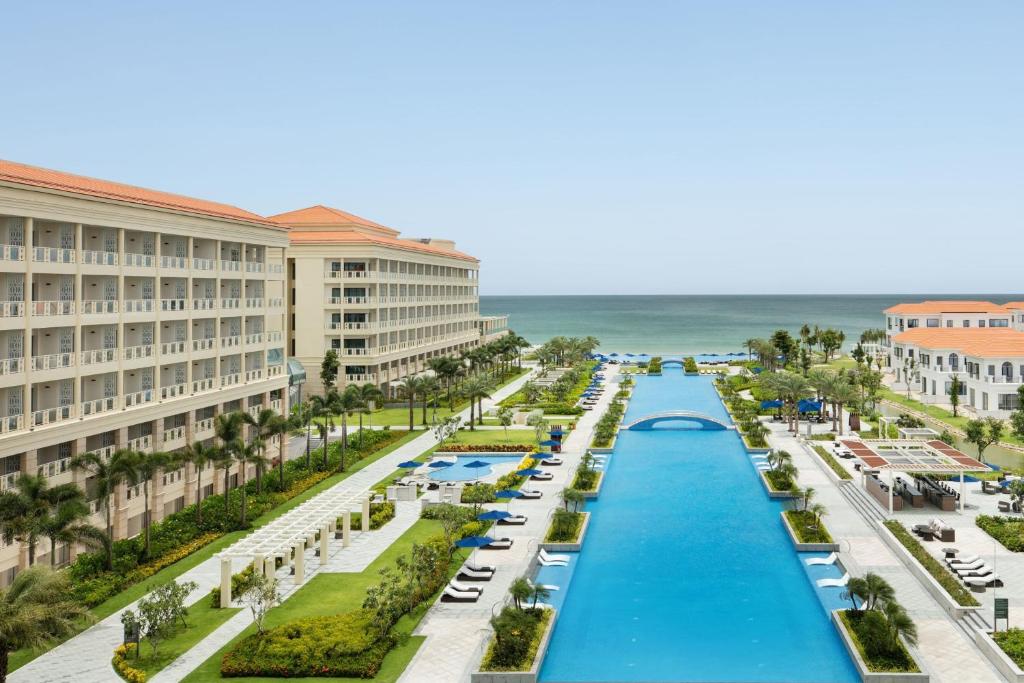
The Sheraton Grand sits on the prime stretch of northern My Khe Beach — direct sand access, a sweeping main pool running parallel to the ocean, and the scale that makes a beach resort actually feel like a beach resort. At 258 rooms it's large enough to have real amenity depth (multiple dining outlets, a proper kids club, fitness centre) without losing individual service quality. Room views from the upper floors look across 20 kilometres of uninterrupted coastline. For most visitors to Da Nang — families, couples, first-timers — this delivers the complete beach resort experience at a price point that makes sense.
Check availability on Booking.com →Sofitel Legend Metropole Hanoi
The Metropole is the most storied hotel in Vietnam and one of the great colonial hotels of Asia. Opened in 1901, it has hosted Graham Greene, Charlie Chaplin, Joan Baez, and every significant figure who has passed through Hanoi over 125 years. The wartime bunker beneath the hotel is a remarkable piece of living history. It sits at the edge of Hoan Kiem Lake in the French Quarter — walking distance from the Opera House and the Old Quarter, while offering a level of calm that the Old Quarter itself cannot provide. The pool and Bamboo Bar are exceptional. This is not merely the best hotel in Hanoi; it is one of the genuinely irreplaceable hotel experiences in the entire country.
Check availability on Booking.com →Who Should Go Where
Hanoi has no beach. This isn't a comparison — it's a requirement. My Khe is one of Vietnam's finest urban beaches. Da Nang is the only answer.
The Old Quarter, Temple of Literature, Ho Chi Minh Mausoleum, and Hoa Lo Prison represent layers of Vietnamese history Da Nang simply cannot replicate.
Beach access, BaNa Hills, Mikazuki Water Park, and a less intense traffic environment make Da Nang the easier family base. Hanoi rewards older children who can engage with history.
If Ha Long Bay is on your list, base from Hanoi — the road transfer is 3.5 hours versus a flight from Da Nang. Hanoi is the natural anchor for any Ha Long cruise.
Lower cost, excellent café culture in An Thuong, a smaller city that preserves energy, and Vietnam's best co-working ecosystem. Hanoi works but Da Nang is purpose-built for this.
Bun cha, pho cuon, banh cuon, cha ca La Vong — Hanoi's food culture is among the most distinct and consistent in Vietnam. Da Nang's Mi Quang is excellent but the depth is narrower.
Da Nang delivers its highlights faster. Beach, Hoi An day trip, Marble Mountains, good dinner — that's a satisfying 3-night trip. Hanoi rewards longer time to absorb properly.
Da Nang winter (18–22°C) is cooler but perfectly comfortable. Hanoi winter can drop to 10°C at night and stays grey and misty for weeks. Beach weather wins in this comparison.
Final Verdict
Da Nang and Hanoi answer different questions. Da Nang answers: where should I go for a beach holiday in Vietnam with good food, easy logistics, and hotel value? Hanoi answers: where should I go to understand what Vietnam actually is — its history, its street life, its intellectual and political identity?
Choose Da Nang if: you want beach access, warm reliable weather, outdoor life, family infrastructure, or digital nomad capability. It's Vietnam's Miami — built to make you comfortable, not to challenge you. The access to Hoi An adds genuine cultural depth without requiring you to leave your beach base for more than a day.
Choose Hanoi if: you want to walk through history, eat Vietnam's most iconic dishes in context, access Ha Long Bay, or experience what a 1,000-year capital actually feels like from the inside. The Old Quarter alone justifies the trip. October and November are the best months to be there.
For most itineraries of 10 days or more, both cities belong on the route. The classic Hanoi–Da Nang–Ho Chi Minh City south-bound Vietnam itinerary exists because it works: each city adds something the others don't have. Flying between Hanoi and Da Nang takes 1 hour 20 minutes and costs $30–60 booked in advance.