Da Nang is fast becoming one of the most talked-about destinations among Australian holiday-makers — and it's easy to see why. It has the beaches, the resort strip, the seafood, and the tropical warmth that Australians love, but without the overcrowding and premium pricing that now define Bali's most popular areas. Flights are increasingly accessible from Sydney, Melbourne, Brisbane, and Perth, and once you arrive, your dollar stretches considerably further than it does in Seminyak or Kuta.
This guide covers everything you need to plan a Da Nang holiday from Australia: which airlines fly there and from which cities, what things cost in AUD, which areas and hotels Australians tend to gravitate towards, what to do, and how Da Nang honestly compares to Bali as a holiday destination.
Quick orientation: Da Nang sits in Central Vietnam, halfway between Hanoi and Ho Chi Minh City. It is a clean, modern beach city of about 1.2 million people. Hoi An — one of Southeast Asia's most beautiful heritage towns — is 30 km to the south and makes an easy day trip or extension stay.
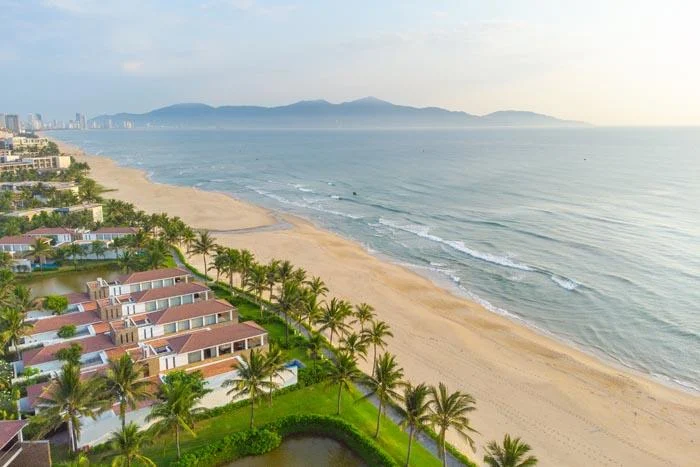
My Khe Beach, Da Nang — 30 km of clean white sand with calm conditions in the dry season.
Flights from Australia to Da Nang
Direct flight options from Australia to Da Nang are limited but improving. Most Australian travelers connect through a hub city in Asia, adding a layover of 1–3 hours. Total travel time from Australia's east coast is typically 10–14 hours including connection.
Sydney (SYD)
The most flight options originate from Sydney. Vietnam Airlines, Jetstar, and Singapore Airlines (via Singapore) all serve the Sydney–Da Nang route. Expect total journey times of around 11–13 hours. Return fares typically run AUD 600–1,100 in economy when booked 6–10 weeks in advance. Peak-period fares (July school holidays, Christmas) push higher.
Melbourne (MEL)
Melbourne flights to Da Nang typically connect through Singapore, Kuala Lumpur, or Ho Chi Minh City. Total journey time is around 12–14 hours. Return economy fares are broadly similar to Sydney: AUD 650–1,150. Vietnam Airlines and Jetstar offer the most competitive pricing on this route.
Brisbane (BNE)
Brisbane travelers generally connect through Singapore or Kuala Lumpur. Total travel time is around 11–13 hours. Fares are comparable to Sydney. AirAsia and Jetstar offer budget options connecting through Kuala Lumpur.
Perth (PER)
Perth actually has the shortest flying distance to Vietnam of any major Australian city. Connections through Kuala Lumpur or Singapore are common. Total travel time is around 8–10 hours, making it the most convenient Australian gateway. Return fares typically run AUD 550–950.
Booking tip: The best fares to Da Nang from Australia are typically found 8–12 weeks in advance. Shoulder season (March–May and September–October) offers the best combination of good weather and lower airfares. Avoid booking around Vietnamese public holidays like Tết (late January/early February) when domestic demand peaks.
Common Layover Cities
Singapore (Changi), Kuala Lumpur (KLIA), Ho Chi Minh City (Tan Son Nhat), and Hanoi are the most common connection points. Singapore and Kuala Lumpur layovers tend to be the smoothest transit experiences. If your layover is 5 hours or more in Singapore, Changi Airport itself is worth exploring — it's consistently ranked among the world's best.
Why Australians Love Da Nang
Beaches Without the Bali Crowds
My Khe Beach runs for nearly 30 km of clean white sand along Da Nang's eastern edge. It lacks the carnival atmosphere of Kuta or the Instagram-saturated scene of Canggu — which is precisely why many Australians who have already done Bali multiple times find it so refreshing. The water is warm, the beach is well maintained, and in the dry season (March to August), conditions are consistently excellent for swimming.
Affordable Luxury Resorts
Some of Vietnam's finest international resorts line My Khe Beach and the adjacent Son Tra Peninsula. Properties like the Hyatt Regency, Furama Resort, and Pullman Da Nang offer the full five-star beach resort experience — multiple pools, spa, direct beach access, fine dining — at prices that would be considered mid-range in Bali's Nusa Dua strip. A quality beachfront resort in Da Nang regularly runs AUD 150–350 per night for a standard room.
Excellent Seafood
Da Nang is a working fishing city with an outstanding seafood culture. The stretch of beach south of the main resort zone is lined with open-air seafood restaurants where you select your own fish, prawns, clams, and lobster from ice displays and they cook it fresh. For Australians accustomed to the price of seafood at home, the value is striking — a full seafood meal for two with beer typically costs AUD 20–40.
Café Culture
Vietnam has one of the world's great coffee cultures, and Da Nang is no exception. The city has a thriving independent café scene with rooftop bars, specialty coffee, and Vietnamese iced coffee (cà phê sữa đá) available everywhere at AUD 1–3 a cup. For Australians who take their coffee seriously, this is a genuine draw.
Easy Hoi An Day Trip
Hoi An is 30 km south of Da Nang and is the most visited heritage town in Vietnam. Its lantern-lit Ancient Town, tailor shops, riverside restaurants, and An Bang Beach make it a natural full-day excursion. A Grab car costs AUD 15–30 each way, and the round trip is easily done in a day from any Da Nang hotel. See our Da Nang 7-day itinerary for a suggested schedule.
Cost of a Da Nang Holiday for Australians
Da Nang offers strong value for Australians at every budget level. The following table uses approximate AUD equivalents based on early 2026 exchange rates (1 AUD ≈ 18,300–18,600 VND).
| Expense | Budget | Mid-Range | Luxury |
|---|---|---|---|
| Hotel (per night) | AUD 25–55 Hostels, guesthouses |
AUD 70–160 3–4 star hotels |
AUD 200–550+ 5-star beachfront resorts |
| Food (per day) | AUD 15–30 Street food, local restaurants |
AUD 35–70 Casual restaurants, cafes |
AUD 80–160+ Resort dining, fine dining |
| Transport (per day) | AUD 5–12 Grab rides, motorbike hire |
AUD 15–30 Regular Grab, day trip transport |
AUD 40–80+ Private driver, tours |
| Activities (per day) | AUD 0–15 Beach, markets, walking |
AUD 20–50 Ba Na Hills, Marble Mtns |
AUD 60–150+ Golf, private tours, spa |
| Total daily estimate | AUD 45–110 | AUD 140–310 | AUD 380–950+ |
For most Australians travelling mid-range, a 10-night Da Nang holiday (excluding flights) can be comfortably done for AUD 1,500–3,000 per person, including accommodation, food, transport, and activities. This compares favourably to equivalent holidays in Bali, Thailand, or the Maldives.
Best Areas for Australians to Stay
| Area | Best For | Hotel Style | Walkability | Beach Access |
|---|---|---|---|---|
| My Khe Beach | Beach holidays, families, couples | Luxury resorts, mid-range hotels | Good along the beach road | Beachfront to 2-min walk |
| An Thuong | Restaurants, nightlife, café culture | Mid-range boutiques, serviced apts | Excellent | 5–10 min walk |
| Son Tra Peninsula | Seclusion, nature, ultra-luxury | Ultra-luxury (InterContinental) | Low — need Grab or car | Private beach cove |
| Han River Area | City sightseeing, Dragon Bridge | Business hotels, mid-range | Very good | 15–20 min drive |
| Hoi An | Culture, romance, heritage | Boutique resorts, heritage villas | Excellent in Ancient Town | 5–15 min to An Bang Beach |
Most first-time Australian visitors base themselves on My Khe Beach — specifically the northern stretch around the Hyatt, Furama, and Pullman cluster, which gives direct beach access while remaining close to the An Thuong café and restaurant strip. Repeat visitors often split their stay, spending 5–6 nights in Da Nang and 3–4 nights in Hoi An.
Da Nang's beachfront resorts offer world-class facilities at prices well below comparable properties in Bali or Thailand.
Hotels Australians Tend to Choose
These are the five properties that come up most often when Australians research Da Nang. For a full comparison, see our Best Hotels in Da Nang guide.
For budget options under AUD 80/night, see our Da Nang budget hotels guide. For the full luxury comparison, see our Da Nang luxury hotels guide.
Things Australians Should Know Before Visiting
Visa Requirements
Australian citizens need a visa to enter Vietnam. The easiest option is the Vietnam e-visa, applied for online via the official Vietnam Immigration portal (evisa.xuatnhapcanh.gov.vn). The e-visa costs USD 25, allows stays of up to 90 days, and is processed within 3–5 business days. Visa on arrival is also available at Da Nang International Airport. Always check the Australian Government's Smartraveller website for the latest entry requirements before booking.
Currency
Vietnam uses the Vietnamese Dong (VND). In early 2026, the approximate rate is 1 AUD ≈ 18,300–18,600 VND. The easiest approach is to bring some cash AUD and exchange it at the airport or in the city, or withdraw VND from ATMs using a Wise, ING, or other low-fee travel card. Most hotels and larger restaurants accept Visa and Mastercard; local markets, street food stalls, and small cafes are cash-only.
Getting Around — Use Grab
Grab is the dominant ride-hailing app across Southeast Asia and works well throughout Da Nang. It's reliable, fairly priced, and safer than hailing unmetered taxis off the street. A cross-city ride costs AUD 2–5. Download the app and add your card before you leave Australia. For day trips to Hoi An or Ba Na Hills, book a private car through Grab or your hotel — it is usually AUD 20–35 for a return transfer with waiting time.
Weather & Best Time to Visit
Da Nang's best weather for beach holidays runs from March through August — consistently hot, dry, and sunny with calm seas. April and May are particularly reliable. The wet season runs from October to January, bringing heavy rain and occasionally typhoons. February (around Tết) brings short, warm days with the occasional shower. For Australians planning around school holidays, the April school holidays align almost perfectly with Da Nang's ideal conditions. For more detail, see our best time to visit Da Nang guide.
Beach Safety Flags
My Khe Beach uses a colour-coded flag system similar to Australian patrolled beaches. Green means safe to swim. Yellow means swim with caution. Red means do not enter the water. Lifeguards patrol the main swimming zones in the dry season. Rip currents can be strong, particularly after rain or during transitional months. Australians with beach experience will find the system intuitive.
Tipping Culture
Tipping is not mandatory in Vietnam, but is appreciated. A tip of 10–15% at restaurants is a kind gesture if the service is good. Tour guides and drivers generally appreciate a small tip at the end of a day. Spa staff typically receive small tips per treatment. At street food stalls, tipping is not expected.
Health & Travel Insurance
Travel insurance is strongly recommended. Medical standards at Da Nang's private international hospitals are adequate for most situations, but serious emergencies may require medical evacuation to Bangkok or Singapore, which is very expensive without coverage. Ensure your policy includes medical evacuation. Check vaccination requirements and recommendations with your GP before travel — standard Vietnam vaccinations include hepatitis A, hepatitis B, and ensuring tetanus is current. Tap water is not safe to drink; bottled water is cheap and universally available.
Hoi An's lantern-lit Ancient Town is 30 km from Da Nang and is considered a must-visit on any Central Vietnam trip.
Best Things to Do in Da Nang
Dragon Bridge Fire & Water Show
Da Nang's most iconic attraction. The Dragon Bridge breathes fire and sprays water every Saturday and Sunday at 9 PM. The show runs for about 15 minutes and draws large crowds to the riverbank. See our Dragon Bridge guide for the best viewing spots. For an elevated perspective, combine with a Han River night cruise, which passes directly under the bridge during the show.
Ba Na Hills & the Golden Bridge
The Golden Bridge — a pedestrian walkway held up by giant stone hands at 1,400 metres elevation — has become one of Vietnam's most photographed structures. Located at the Ba Na Hills mountain resort 25 km from the city, the complex also includes a French village, amusement rides, and sweeping cloud-level views. Entry and cable car are included in one ticket. Recommended for families and couples alike.
Hoi An Ancient Town
The UNESCO-listed Ancient Town of Hoi An is an easy 30 km drive from Da Nang. Lantern-lit streets, centuries-old merchant houses, an outstanding food scene, and An Bang Beach make it one of the most enjoyable towns in Southeast Asia. Most Australians rate it as a highlight of their Central Vietnam trip. See our 7-day itinerary for how to structure a day trip or overnight stay.
Marble Mountains (Ngũ Hành Sơn)
Five limestone and marble formations rising from the coastal plain 8 km south of the city. Inside are Buddhist sanctuaries, caves, and elevated lookout points offering views across the coast toward Hoi An. Entry is very affordable (around AUD 1.50). Allow 1–2 hours. Combines well with a stop at the nearby Non Nuoc marble sculpture village.
Son Tra Peninsula
A forested peninsula jutting into the South China Sea just north of Da Nang, Son Tra offers jungle roads, wildlife (including rare red-shanked douc langurs), secluded beaches, and the Linh Ung Pagoda with its 67-metre Lady Buddha statue overlooking the bay. Hire a motorbike for the morning, join a jeep tour, or take a Grab to the summit lookout.
Da Nang Markets
Han Market in the city centre and the Son Tra Night Market are the main options for souvenir shopping, local produce, and street food browsing. For a more detailed guide to Da Nang's markets and Hoi An's famous night market, see our Da Nang market guide.
Da Nang's coastline — a less-crowded, more affordable alternative to Bali that's winning over Australian travelers.
Da Nang vs Bali for Australians
This is the question most Australians ask when researching Da Nang. The honest answer: they are different experiences, and both have genuine merit. The comparison below focuses on what actually matters to most Australian holiday-makers.
| Category | Da Nang | Bali |
|---|---|---|
| Flights from Australia | 10–14 hrs with 1 connection. Fewer direct options. | 6–8 hrs. Multiple direct options from Sydney, Melbourne, Brisbane, Perth. |
| Cost | Comparable to or slightly cheaper than Bali, especially for accommodation and food. | Bali's tourist areas (Seminyak, Canggu) have become noticeably more expensive in recent years. |
| Crowds | Much less crowded. My Khe Beach rarely feels busy. | Kuta, Seminyak, and Canggu are heavily trafficked and can feel saturated. |
| Beaches | Clean, long, well-maintained. Calm in dry season. | Kuta / Legian: good surf but busy. Nusa Dua: calmer and cleaner. Uluwatu: spectacular but not safe for swimming. |
| Food | Outstanding Vietnamese cuisine. Great seafood. Strong café culture. | Excellent — from warungs to world-class restaurants. More variety in the luxury segment. |
| Cultural experiences | Hoi An Ancient Town, Marble Mountains, Hue day trip. | Ubud art scene, temple culture, traditional dance performances. |
| Travel ease | Very easy. Grab works well. Scams are rare. | Generally easy, though traffic in south Bali is a genuine issue. Tourist scams are more common. |
| Best for | Beach + culture combo, families, couples wanting a less-crowded luxury resort holiday. | More diverse activities, nightlife, established expat/tourist infrastructure, shorter flight. |
Our take: If you have done Bali 2–3 times and want something fresher, Da Nang is the obvious next step. If you are travelling with children and want the absolute easiest logistics, Bali's shorter flights and more established tourism infrastructure have an edge. For pure beach resort value, Da Nang wins.