Markets Guide · Da Nang & Hoi An · 2026

Da Nang & Hoi An Markets: Han, Con & Night Market Guide

Updated March 2026· By Ryan Yousefi, Editor· 5 markets reviewed
Ryan Yousefi
Ryan Yousefi
Editor · Da Nang Hotel Guide · Based in Da Nang since 2022
Last updated
March 2026

In Vietnam, a market is not just a place to buy things — it is infrastructure. Chợ (market) is where the city feeds itself, where commerce happens outside of retail, and where the social rhythm of Vietnamese daily life is most visible. Understanding the difference between a local market and a tourist night market is the first thing any visitor to central Vietnam should know before they arrive.

Da Nang's markets — Han and Con in particular — are working commercial hubs that happen to be accessible to tourists. Hoi An's markets split between the Central Market (local, morning-only, unamplified) and the Night Market (curated for visitors, lantern-lit, priced accordingly). Neither is fake; both are selective versions of Vietnamese commerce aimed at different audiences.

This guide covers all five major markets across both cities: what each is actually good for, where prices are negotiable and where they're not, what's worth buying and what to skip, and which market matches your travel style. Come with cash, comfortable shoes, and realistic expectations.

Da Nang Markets

Da Nang · Central Market

Han Market (Chợ Hàn)

Mixed: Local + Tourist Tourist Friendly
Location
119 Tran Phu St, Hai Chau
Hours
6am – 7pm daily
Best Time
7am – 9:30am
Floors
2 floors + mezzanine

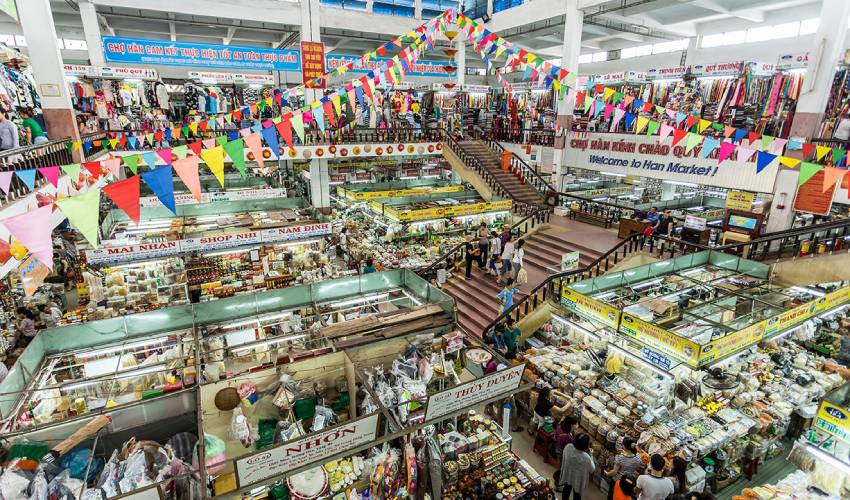
Han Market occupies a dedicated building at 119 Tran Phu Street, Hai Chau 1 Ward — on the Han River waterfront in Hai Chau District, three kilometres from My Khe Beach. The ground floor is the most rewarding: fresh produce, street food stalls, spice vendors, and a wet market section. The upper floors transition into souvenirs, clothing, and tailoring — the section most visitors default to. The building is well-ventilated by Vietnamese market standards but gets noticeably hot by late morning.

Han Market is Da Nang's best-known market and the one most guidebooks direct tourists to. Its reputation rests on three things: the tailoring services on the upper floors, the ground-floor food stalls serving local breakfast and snack dishes, and the range of Vietnamese souvenirs. It functions simultaneously as a local market for city residents buying produce and a tourist market for visitors buying gifts.

Han Market's upper floor has a dense concentration of tailors offering made-to-measure clothing in 24–48 hours. Quality varies significantly between stalls. For made-to-measure work, negotiate a firm price and turnaround time before agreeing, bring a reference garment or clear images, and request a fitting before final handover. Budget 300,000–800,000 VND for a simple item; tailored ao dai (Vietnamese dress) runs 500,000–1,500,000 VND depending on fabric. Note: for serious tailoring, Hoi An has a deeper tradition and wider range of quality operators.

The ground floor food section is Han Market's most authentic element. Stalls serve mì Quảng (Da Nang's turmeric noodle dish, 40,000–60,000 VND), bánh mì, bún bò, chè (Vietnamese sweet soups), and freshly squeezed sugarcane and fruit juices. The atmosphere at 7–8am is genuinely local — this is where Da Nang workers grab breakfast, not primarily a tourist experience. Point-and-gesture works fine for ordering.

The souvenir selection is standard Vietnam: lacquerware, silk products, bamboo items, coffee, dried fruit, conical hats, embroidery. The same items are available in Hoi An and at most tourist markets — Han Market doesn't have exclusive products. Prices are negotiable (aim for 40–60% of the opening price on small items). Quality control is the visitor's responsibility — inspect items before buying.

Expect to negotiate for souvenirs and clothing. Open with 50% of the asking price and settle around 60–65%. Be polite and calm — smile, express genuine interest in the item, and be willing to walk away. Never feel pressured. For food stalls with visible price lists, the price is fixed. For fresh produce in the ground-floor wet market, light negotiation on larger quantities is normal.

Strengths
  • Best local breakfast stalls in Da Nang
  • Central location, easy Grab access
  • Tailoring available same-day or next-day
  • More manageable scale than Con Market
  • English widely spoken in tourist sections
Limitations
  • Hot and crowded by 10am
  • Souvenir quality inconsistent
  • Tourist pricing in upper floors
  • Smaller than Con Market
  • Limited parking; walk or Grab
Da Nang · Largest Market

Con Market (Chợ Cồn)

Predominantly Local
Location
Ông Ích Khiêm St, Hai Chau
Hours
5am – 8pm daily
Best Time
6am – 9am
Scale
Da Nang's largest

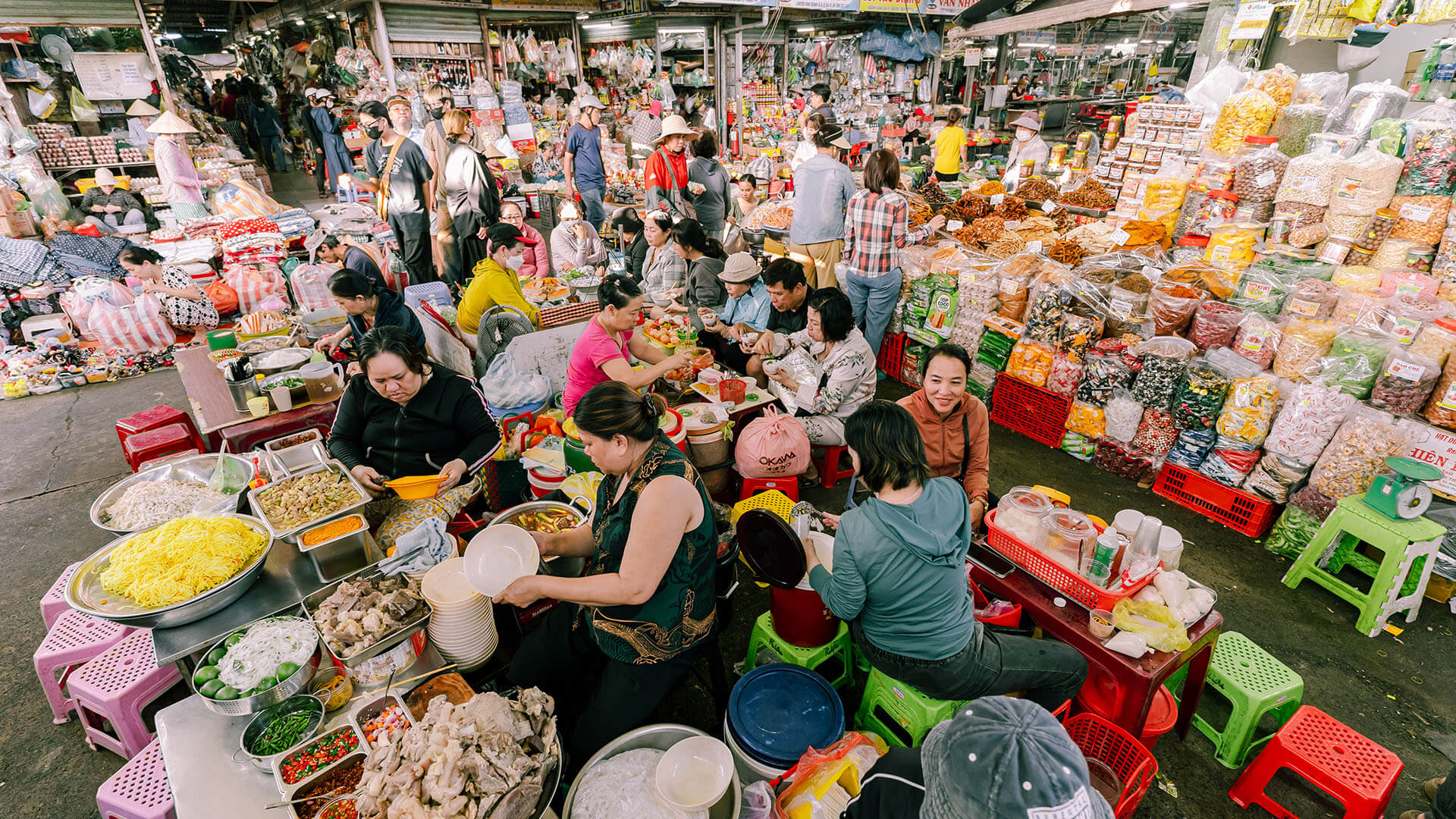
Con Market is Da Nang's largest market and serves the city's population rather than its visitors. It's a multi-floor commercial complex covering fresh produce, meat, fish, dry goods, electronics, clothing, household items, and street food — the kind of market that makes Han Market look curated by comparison. There is minimal English signage, few vendors speak English fluently, and the experience is genuinely unfiltered. This is where Da Nang shops for daily life.

Con Market's food court and surrounding street food vendors represent some of the most authentic and cheapest eating in Da Nang. Dishes include bún chả cá (Da Nang fish cake noodle soup, 40,000–70,000 VND), mì Quảng, bánh tráng cuốn thịt heo (rice paper pork rolls), and an extensive range of chè. The lack of tourist menus means Google Translate camera is your menu — point it at the chalk board or laminated card and order accordingly.

Con Market prices are consistently 20–40% lower than Han Market for equivalent items, because the customer base is local. Produce, dry goods, and food are all priced at local rates. Souvenir and clothing vendors in Con Market are fewer and less polished than Han, but prices reflect this — haggling starts from a lower opening price. If the goal is authentic Vietnamese market shopping at genuine prices, Con Market is the honest answer.

Con Market rewards visitors who are comfortable navigating without English support and who prefer the texture of a real working market over a tourist-friendly experience. It's excellent for photography, for buying local food products (coffee, spices, dried goods) at local prices, and for understanding daily Vietnamese commercial life. Solo travellers, return visitors, and anyone with even basic Vietnamese food knowledge will get more out of Con than Han.

Strengths
  • Da Nang's largest, most authentic market
  • Cheapest food and produce prices
  • Best street food concentration
  • Genuine local atmosphere
  • Coffee, spices, dried goods at local rates
Limitations
  • Almost no English — bring translation app
  • Less polished, more chaotic than Han
  • Fewer souvenir options for tourists
  • Can feel overwhelming for first-time visitors
  • Wet market sections are strong-smelling
Da Nang · Night Market

Son Tra Night Market

Tourist Oriented Evening Only
Location
Near Dragon Bridge
Hours
5pm – 11pm daily
Best Time
7pm – 9:30pm
Atmosphere
Outdoor, open-plan

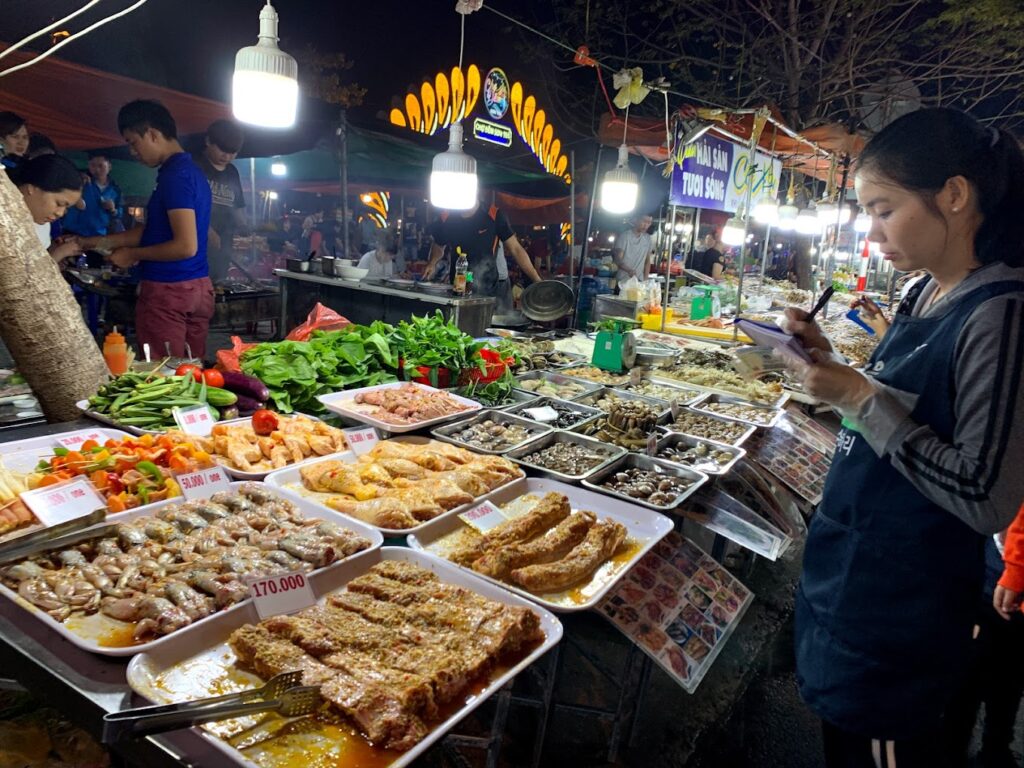
Son Tra Night Market is Da Nang's main evening market, positioned near the Dragon Bridge and Han River — the same area that draws tourists for the Saturday and Sunday fire-breathing show. The market is more relaxed and less crowded than Hoi An's Night Market, with a mix of food stalls (grilled seafood, bánh tráng nướng, fresh fruit, boba), souvenir vendors, and local clothing stalls. It lacks the atmosphere of Hoi An — no lanterns, no ancient town backdrop — but it's an accessible evening activity that pairs naturally with a Dragon Bridge visit. Food quality at the grilled seafood stalls is generally good. Souvenir quality follows standard Vietnam market patterns. Bargaining applies to non-food items.

Strengths
  • Natural pairing with Dragon Bridge evening
  • Good grilled seafood and street snacks
  • Less crowded than Hoi An Night Market
  • Open-air, easy to navigate
Limitations
  • No distinctive atmosphere vs other night markets
  • Generic souvenir range
  • Tourist pricing throughout
  • Less compelling than Hoi An equivalent

Hoi An Markets

Hoi An · Local Market

Hoi An Central Market (Chợ Hội An)

Predominantly Local Morning Only
Location
Tran Phu St, Ancient Town
Hours
5am – 12pm (best before 9am)
Best Time
6am – 8:30am
Focus
Produce + Food + Tailors

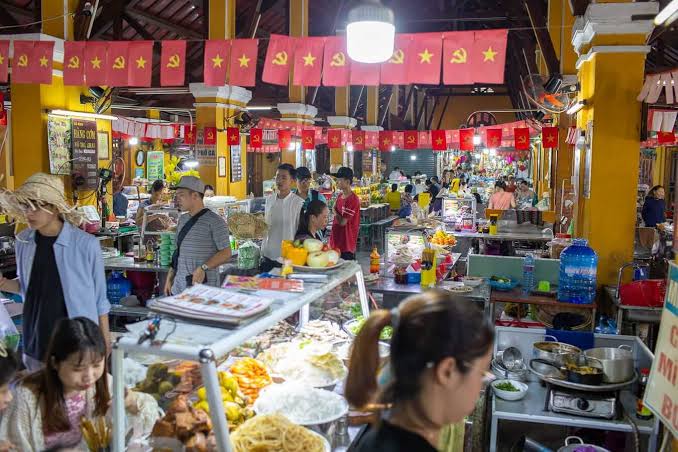
Hoi An Central Market is a genuine working market serving the town's population and surrounding villages. The morning produce section — herbs, vegetables, live seafood, spices, and fresh noodles — is the market at its best. This is the ingredient source for Hoi An's famous restaurant kitchens, and visiting early means seeing the full freshness of the supply chain. It's also the starting point for cooking classes that begin with a guided market tour.

The covered food stall section serves Hoi An specialties at local prices: cao lầu (150,000–200,000 VND), cơm gà (50,000–80,000 VND), and bánh mì from the legendary Bánh Mì Phương stall, 2 minutes from the market. Several of Hoi An's best cooking class operators start their morning sessions with a guided tour of this market before heading to the kitchen — one of the better ways to understand what you're looking at and eating.

The streets immediately surrounding Hoi An Central Market — particularly Tran Phu and Le Loi — have the highest concentration of tailoring workshops in Hoi An. Quality ranges from very good (family-run workshops with 20+ years of history) to inconsistent (walk-in tourist operations). For made-to-measure clothing, allow minimum 48 hours for quality work, bring reference garments or clear photos, agree on the final price including alterations before work begins, and request a fitting. Budget 500,000–2,000,000 VND for a quality tailored item.

Arrive before 8:30am for the full market experience — the produce section has largely wound down by 9:30am and the stalls begin packing up by 10–11am. The contrast between the Central Market at 7am and the same streets at noon is significant: early morning is one of the most atmospheric times in Hoi An, and the market is central to that experience. Pair with breakfast and a walk through the ancient town lanes before tour groups arrive.

Strengths
  • Most authentic market experience in the region
  • Best context for cooking class participants
  • Proximity to the best tailor workshops
  • Genuine local prices for produce and food
  • Beautiful in early morning light
Limitations
  • Morning-only — largely finished by midday
  • Limited souvenir offering
  • Can be crowded on cooking class mornings
Hoi An · Night Market

Hoi An Night Market (Chợ Đêm Hội An)

Tourist Focused Atmospheric
Location
Nguyen Hoang St
Hours
5pm – 11pm daily
Best Time
7pm – 9pm
Atmosphere
Lantern-lit, iconic

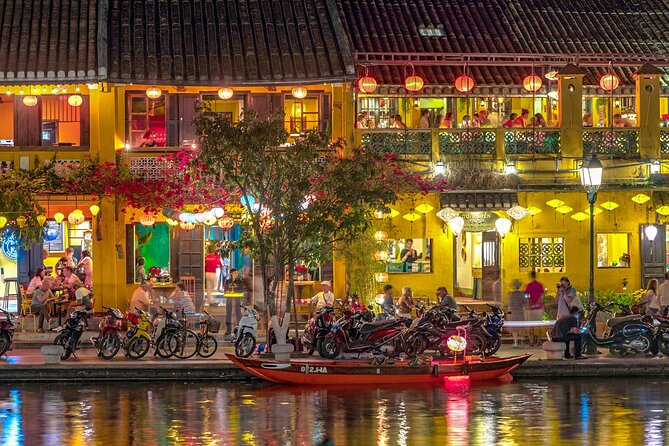
The Hoi An Night Market is the most photographed market in central Vietnam. Silk lanterns in every colour hang above Nguyen Hoang Street, the Thu Bon River glitters nearby, and the ancient town's yellow walls glow in the evening light. The atmosphere is genuinely beautiful and unlike anything in Da Nang. This is the version of Hoi An that appears in every travel campaign, and it earns its reputation for atmosphere unconditionally.

The Night Market is unambiguously tourist-oriented. Stall products repeat significantly — lanterns, silk scarves, embroidered items, keyrings, paintings — and opening prices are set at tourist levels. Bargaining is expected and effective: start at 40–50% of the asking price. Food stall prices are 20–50% higher than equivalent items in the Central Market or local restaurants. The experience trades authenticity for atmosphere and does so without pretence — both parties understand the arrangement.

Food options at the Night Market include bánh mì (45,000–70,000 VND), fresh spring rolls, grilled corn and sweet potato, bánh xèo (crispy Vietnamese crêpe), and a range of fruit and dessert stalls. The bánh tráng nướng (grilled rice paper "pizza") is popular and genuinely good. Several stalls serve local Quảng Nam specialties. Quality is variable — find the stall with the longest queue of Vietnamese visitors, not tourists, for the best version.

The Night Market is both visually spectacular and primarily commercial — these are not contradictions. The lanterns are genuinely handmade by Hoi An families, the street food is genuinely Vietnamese, and the atmosphere is genuinely beautiful at 7–8pm before the crowds peak. The inauthenticity critique applies mainly to the souvenir pricing and the repetition of products, not to the cultural experience of being there. Go with realistic expectations: experience first, shopping second.

Strengths
  • Most atmospheric market in central Vietnam
  • Best place to buy handmade silk lanterns
  • Good street food options when chosen carefully
  • Beautiful photography setting at golden hour
  • Easy walking from the Ancient Town
  • Heavily tourist-priced throughout
  • Stall products repeat significantly
  • Very crowded 7:30–9pm in peak season
  • Food prices well above local market
  • Full Market Comparison

    Market City Best For Tourist Level Food Quality Souvenirs Bargaining Atmosphere
    Han Market Da Nang Tailoring, breakfast, tourist intro Medium Good Standard Essential Functional, pleasant
    Con Market Da Nang Local food, cheapest prices, authenticity Low Excellent Limited Essential Raw, unfiltered, genuine
    Son Tra Night Market Da Nang Evening activity near Dragon Bridge High Decent Generic Yes Pleasant, unremarkable
    Hoi An Central Market Hoi An Morning produce, cooking classes, tailors Low–Med Excellent Minimal For produce Authentic, photogenic
    Hoi An Night Market Hoi An Atmosphere, lanterns, evening experience Very High Variable Good (lanterns) Essential Spectacular, iconic

    What to Buy (and What to Skip)

    Vietnamese Coffee

    Con Market and Han Market both have spice/dry goods vendors selling whole bean and ground Vietnamese robusta coffee. Buy beans, not pre-ground — robusta degrades quickly once ground. Trung Nguyen is the reliable brand; ask for "cà phê nguyên hạt" (whole bean). Con Market prices: 80,000–150,000 VND per 500g.

    Best price: Con Market
    🏮
    Silk Lanterns (Hoi An)

    Authentic handmade silk lanterns are Hoi An's best souvenir and available nowhere else in the same quality. Look for silk or cotton fabric (not polyester), bamboo frames, and hand-stitched seams. Ask if they make on-site. Collapsible versions travel well. Prices: 100,000–300,000 VND for quality pieces. The Night Market and workshop streets around Tran Phu are the best sources.

    Buy at: Hoi An Night Market or workshop streets
    🥭
    Dried Fruit & Snacks

    Both Han and Con markets have vendors selling vacuum-packed dried mango, jackfruit, dragonfruit, and sweet potato chips — all genuinely good and distinctly Vietnamese. Con Market has better prices and fresher stock turnover. Check the packaging date and buy sealed bags. Weight-efficient souvenirs that travel well without customs issues in most countries.

    50,000–120,000 VND per 250g pack
    🌶
    Spices & Sauces

    Con Market's spice section sells Vietnamese cinnamon (cassia), star anise, dried chilli, and pho spice mixes at prices significantly below supermarkets or tourist shops. Buy fresh whole spices, not pre-packaged blends if possible. Fish sauce (nước mắm) and shrimp paste travel less well in luggage — sealed bottles are fine but airline rules apply.

    Best selection: Con Market ground floor
    👗
    Tailored Clothing

    Hoi An is Southeast Asia's best tailoring destination. For quality results: visit multiple workshops before committing, bring clear reference photos or a garment to copy, allow 48–72 hours minimum for quality work (same-day is rush work), and insist on a fitting before collection. Budget 500,000–2,500,000 VND for a well-made item. Han Market tailors are functional for simple items; don't expect Hoi An quality.

    Best quality: Hoi An workshop streets
    🎨
    Lacquerware & Handicrafts

    Vietnamese lacquerware (bowls, boxes, trays with embedded eggshell or mother-of-pearl) is produced in workshops around Hoi An and sold at most markets. Quality varies dramatically. Authentic handmade lacquerware has deep, even colour, smooth finish, and visible craft quality. Mass-produced imports have shallow colour and rough edges. Price is a reasonable proxy for quality — 200,000 VND for a lacquer bowl is probably not handmade.

    Allow 200,000–800,000 VND for quality pieces
    ⚠️
    What to Avoid

    Branded goods at market prices (counterfeit — customs risk in many countries). Coral or shell products (prohibited import/export in most countries, fined on arrival home). Ivory or bone carvings (same issue). Pre-packaged "natural" cosmetics from unmarked stalls (no ingredient labelling, unknown content). "Antiques" at market prices — almost universally reproductions. Cheap silk — usually polyester; the burn test works: silk chars, polyester melts.

    🎁
    Quality vs Mass-Produced

    The reliable indicators: weight (real silk and lacquerware are heavier than synthetic equivalents), finishing detail (hand-stitching is visible and slightly irregular; machine work is perfectly uniform), origin (ask directly where and by whom it was made — workshops will answer confidently, resellers won't), and price (genuine craft work cannot be sold for 50,000 VND and sustain the maker). When in doubt, buy directly from a workshop rather than a market stall.

    Workshop-direct = better price and provenance

    Practical Tips for Visiting Markets

    Cash vs Card

    Bring cash — almost all market vendors in Da Nang and Hoi An are cash only. Small denomination VND notes (20,000, 50,000, 100,000) are more practical than large bills (500,000) which vendors may struggle to change for small purchases. Withdraw from a Vietcombank or BIDV ATM before the market visit. Keep cash in a front pocket or money belt in crowded sections, not in a back pocket or open bag.

    Best Time of Day

    Morning (6–9am) is the best window for Con Market, Han Market, and Hoi An Central Market — freshest produce, coolest temperature, and most authentic local atmosphere before tourist foot traffic builds. Night markets operate from 5–6pm; the best window is 6:30–8:30pm when stalls are fully operational but before the densest crowds. Avoid any indoor market between 10am and 2pm in June–August — the heat is significant.

    How to Bargain Politely

    Smile, make genuine eye contact with the vendor, and express actual interest in the item before negotiating. Open with 50–60% of the asking price. Don't lowball aggressively — an offer of 20% of asking price is insulting and shuts down the negotiation. Accept the first counteroffer that's within 15–20% of your target. Once you agree on a price, complete the purchase — backing out after agreement is poor form. Walk away calmly if the gap is too large; vendors sometimes call you back with a better price.

    Food Hygiene

    Local market food is generally safe and vendors have strong incentives to maintain quality — they serve the same customers every day. Risk increases for anything that has been sitting out in heat for extended periods: choose stalls where food is cooked to order and has visible turnover. Avoid raw shellfish from market vendors unless from a known-quality stall. Street food at Con Market and Hoi An Central Market that's been served to locals for years is a reliable indicator of food safety in practice.

    Avoiding the Heat

    Indoor markets (Han, Con, Hoi An Central) have limited ventilation. In June–August, plan market visits for before 9am or after 5pm. Carry a small bottle of water. Wear breathable cotton or linen. Take breaks at the market's edge where airflow is better. The Hoi An Night Market has natural ventilation being outdoor and open-plan — more comfortable in summer evenings than indoor daytime markets.

    Safety Overview

    Da Nang and Hoi An markets are safe by regional standards. Pickpocketing in dense crowds is the primary risk — use a crossbody bag worn in front, keep your phone in a closed pocket when not in use, and don't leave bags unattended at food stalls. The Hoi An Night Market at peak hour (7:30–9pm in high season) is the densest crowd environment in the region and warrants the most awareness. Violent crime at or near markets is extremely rare.

    Which Market Is Best for You?

    Traveller TypeBest MarketWhy
    First-time visitorsHan Market (morning)English-friendly, accessible, good breakfast stalls, central location. Manageable introduction to Vietnamese market culture.
    Food-focused travellersCon Market + Hoi An CentralCon Market for Da Nang's best street food at local prices; Hoi An Central for morning cooking class context and regional specialties.
    Atmosphere seekersHoi An Night MarketNo market in the region matches the visual atmosphere. Go in with experience expectations rather than shopping expectations.
    Budget travellersCon MarketDa Nang's cheapest prices for food, produce, and dry goods. No tourist markup. Rewards confidence with low-cost, high-quality eating.
    Couples / HoneymoonersHoi An Night Market + CentralNight Market for the evening atmosphere; Central Market the following morning for the contrast and cooking class option.
    Families with childrenHan Market + Son Tra NightHan Market is manageable and English-friendly. Son Tra Night Market is open-air with food options children will eat. Both are low-stress.
    Digital nomadsCon Market (weekly shop)Best source for coffee, snacks, and groceries at local prices. A 45-minute visit replaces a supermarket run at significantly lower cost.
    Luxury travellersHoi An Night Market (lanterns) + tailorsThe lantern purchase and a well-chosen tailoring workshop are the two market activities that scale up in quality and experience at higher spend.
    PhotographyHoi An Central Market (dawn) + Night MarketCentral Market at 6–7am offers the best unposed market photography in the region. Night Market offers the most visually distinctive evening setting.

    7-Day Itinerary — where markets fit in a full week across Da Nang and Hoi An.
    Da Nang Dining Guide — restaurant picks and food scene overview beyond the markets.
    Budget Guide — how much to budget for shopping and food across the trip.
    Transport Guide — Grab routes to Han Market, Con Market, and Hoi An.
    Travel Mistakes Guide — includes common shopping and transport mistakes to avoid.

    Common Questions

    Da Nang & Hoi An Markets: FAQ

    Is Han Market worth visiting in Da Nang?
    Yes, with adjusted expectations. Han Market is Da Nang's most accessible market for tourists and worth a morning visit for its food stalls, tailoring options, and atmosphere. The souvenirs are standard Vietnam market fare, but the ground-floor breakfast stalls (mì Quảng, bánh mì, freshly squeezed juice) serve food locals actually eat at prices locals pay. Budget 1.5–2 hours, go before 10am, and start on the ground floor rather than the souvenir floors. If authenticity is more important than convenience, Con Market is more interesting — but Han is the better starting point for a first market visit.
    Is the Hoi An Night Market a tourist trap?
    Partially, but that framing misses the point. The Hoi An Night Market is genuinely beautiful — lanterns overhead, the Thu Bon River nearby, and an atmosphere unlike anywhere else in Vietnam. The souvenir prices are tourist-facing and stalls repeat significantly, but this is transparent rather than deceptive. The food ranges from excellent local street dishes to generic tourist fare — find the stall with a Vietnamese queue. Go with the right expectation: experience and atmosphere first, shopping second. For authentic local shopping, the morning Central Market on Tran Phu is a better option.
    Do you need to bargain at Vietnamese markets?
    At markets and souvenir stalls, yes — bargaining is standard and expected. The opening price is typically 1.5–3x what will be accepted. A polite counter-offer at 50–60% of asking, with a smile and willingness to walk away, is normal practice. Don't bargain at food stalls with posted prices, at supermarkets, or at established restaurants. For tailors, negotiate the total price before work begins and confirm it includes alterations. Avoid aggressive bargaining over small amounts — the friction isn't worth a 10,000 VND difference.
    Are Da Nang and Hoi An markets safe at night?
    Yes — both cities are safe by Southeast Asian standards. Pickpocketing at dense crowds is the primary risk. Use a front-facing bag or money belt, keep your phone in a closed pocket when not in use, and don't carry your passport to markets. The Son Tra Night Market in Da Nang is open-plan and low-risk. The Hoi An Night Market has denser crowds and warrants slightly more awareness at peak hours (7:30–9pm in high season). Violent crime at either market is extremely rare.
    What is the biggest market in Da Nang?
    Con Market (Chợ Cồn) is the largest market in Da Nang by floor area and product range — a sprawling multi-floor complex covering fresh produce, dry goods, electronics, clothing, food, and household items that serves the city's local population. Han Market (Chợ Hàn) is smaller but better known to tourists due to its central location and souvenir focus. For sheer scale of a working Vietnamese market, Con Market is the more impressive, though it requires comfort navigating without English signage.
    Can you buy authentic silk lanterns in Hoi An?
    Yes — Hoi An is the origin of Vietnam's silk lantern tradition and genuine handmade lanterns are available. Look for silk or cotton fabric (not polyester — the burn test confirms: silk chars, polyester melts), bamboo or wire frames, and visible hand-stitching at the seams. Ask vendors whether they make on-site — workshop-made lanterns are more reliably authentic than resellers. Collapsible versions travel well. Prices for quality handmade lanterns start at around 100,000–300,000 VND. The Night Market and the workshop streets around Tran Phu and Hoang Van Thu are the best sources.